Godrej Whitefield vs Lodha Hopefarm Whitefield: the ₹2.75 crore gap
Both projects sit inside the same four-kilometre stretch of Whitefield, both are unbuilt, and both are waiting on a Karnataka RERA number. Almost everything a buyer usually compares, from the corridor and the employer catchment to the schools and the operational Purple Line, is common ground. What is not common ground is money. Godrej Whitefield is being positioned around indicative floors of ₹1.25 crore for a 2 BHK and ₹1.65 crore for a 3 BHK on roughly 20 acres near NH-648 Main Road. Lodha Hopefarm Whitefield opens at about ₹4 crore for a 3.5 BHK of roughly 2,500 sq ft on an 8-acre parcel at Hope Farm Junction. That is a ₹2.75 crore step at the entry rung, and it decides this comparison long before any amenity list does.
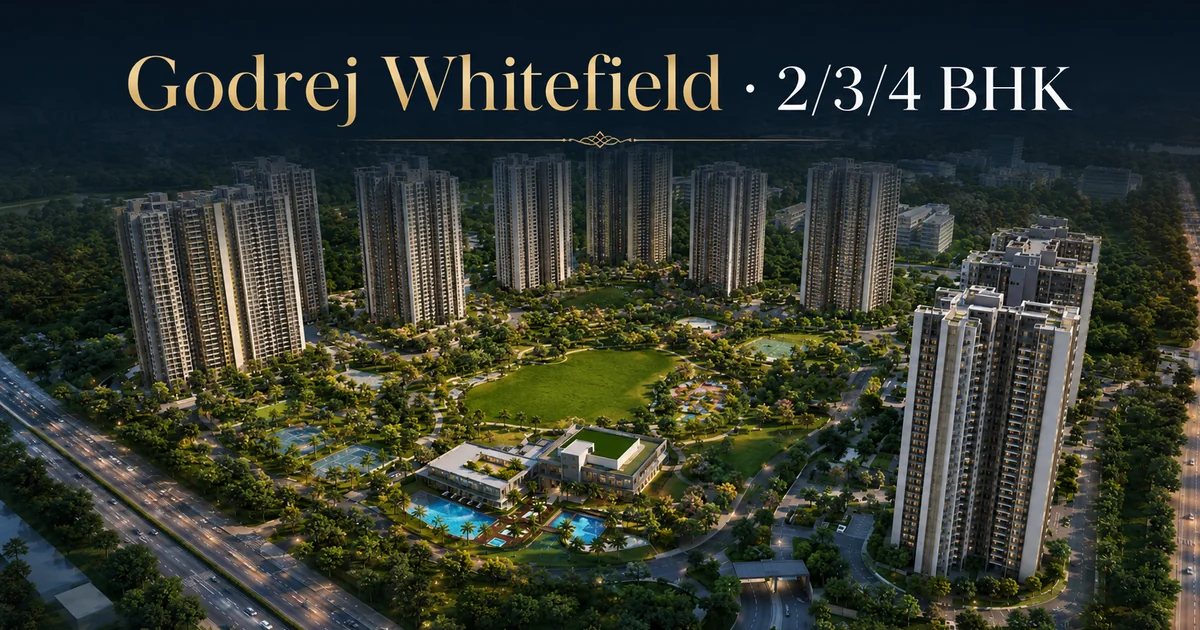
At a glance: Godrej Whitefield vs Lodha Hopefarm Whitefield
| Factor | Godrej Whitefield | Lodha Hopefarm Whitefield |
|---|---|---|
| Entry ticket | ₹1.25 Cr for the 2 BHK (indicative, pre-launch) | About ₹4 Cr for the 3.5 BHK (indicative) |
| Implied rate per sq ft | About ₹10,900 at the indicative floor; about ₹12,270 on the developer's own ₹1,350 Cr over 1.1 msf disclosure | About ₹16,000 at ₹4 Cr on 2,500 sq ft |
| Configurations | 2, 3 and 4 BHK, about 1,150 to 2,900 sq ft (anticipated) | 3.5, 4 and 5 BHK, about 2,500 to 5,000 sq ft |
| Land area | About 20 acres | About 8 acres |
| Homes planned | Not announced; about 1.1 million sq ft of developable area disclosed | Not announced; six towers planned |
| Build intensity | About 1.26 sq ft of building per sq ft of land (derived) | Not computable until the unit count is filed |
| Possession | Not announced | Indicative 2030 window, subject to the RERA filing |
| RERA status | Registration awaited; no number exists | Registration awaited; none found as of 21 May 2026 |
| Launch stage | Pre-launch; no interest window open as of July 2026 | Pre-launch; cost sheet awaited |
| Developer record | Godrej Properties: FY26 bookings ₹34,171 Cr, up 16 per cent; Bengaluru ₹8,802 Cr | Lodha, brand of Macrotech Developers Ltd: listed, MMR and Pune core, young Bengaluru book |
| Micro-location | Corridor level near NH-648 Main Road; village and survey number not public | Hope Farm Junction, opposite Mahindra Blossom, beside Alembic City |
| Purple Line reality | Operational since 2023, but Hope Farm is 3 to 5 km and Kadugodi 5 to 6 km away | Operational since 2023, inside the Hopefarm Channasandra and Kadugodi catchment |
The Rs 2.75 crore step, before a single amenity is compared
Start with the only number that matters at the shortlist stage. Godrej Whitefield is being guided at indicative pre-launch floors of ₹1.25 crore for a 2 BHK, ₹1.65 crore for a 3 BHK and roughly ₹2.6 crore for a 4 BHK. These are market-derived figures, not a developer cost sheet, because no cost sheet exists as of July 2026. Lodha Hopefarm Whitefield is guided from about ₹4 crore, and that is the entry rung of its ladder, not the top of it.
Translate that into what leaves your account. Both homes are under construction when you buy, so both attract GST at 5 per cent; Karnataka stamp duty runs 5.6 per cent and registration about 1 per cent of agreement value. That is roughly 11.6 per cent on top of the base price before floor rise, parking, clubhouse charges or corpus are added.
- On a ₹1.25 crore Godrej 2 BHK, those three statutory heads come to about ₹14.5 lakh.
- On a ₹4 crore Lodha 3.5 BHK, the same three heads come to about ₹46.4 lakh.
- The ₹32 lakh difference in taxes and registration alone is larger than the entire 20 per cent down payment on the Godrej home.
The borrowing gap tells the same story at scale: roughly ₹1 crore against roughly ₹3.2 crore. Whatever rate you are offered, the monthly outflow is more than three times larger and it runs for two decades. If your household cannot service a ₹3.2 crore loan comfortably, the rest of this comparison is academic, and there is no shame in that, because these two projects were never designed for the same buyer in the first place.
The only place these two inventories actually touch
Set the two ladders side by side and the overlap is almost invisible. Godrej Whitefield anticipates 2 BHK homes of about 1,150 to 1,250 sq ft, 3 BHK homes of about 1,600 to 1,850 sq ft and 4 BHK homes of about 2,450 to 2,900 sq ft. The Lodha ladder runs 3.5 BHK at 2,500 to 2,800 sq ft, 4 BHK at 3,200 to 3,800 sq ft and 5 BHK at 4,200 to 5,000 sq ft, as set out on its floor plans page.
Everything below 2,450 sq ft has no Lodha equivalent. Everything above 2,900 sq ft has no Godrej equivalent. The two ranges meet only in a narrow band between roughly 2,500 and 2,800 sq ft, where the largest anticipated Godrej 4 BHK sits against the smallest Lodha 3.5 BHK.
That single band is where the comparison gets sharp. For broadly the same floor area, the Godrej indicative ask is about ₹2.6 crore and the Lodha ask is about ₹4 crore, a premium near 54 per cent for the same square footage on the same corridor. What the premium buys is bedroom count relative to area, since a 3.5 BHK laid out across 2,600 sq ft is far more generously proportioned than a 4 BHK in the same envelope, plus a higher specification level and a building full of neighbours who bought at the same ticket.
One caveat cuts against Godrej here. Its sizes are anticipated, not filed. No sanctioned plan exists, so the 2,450 to 2,900 sq ft band could move at launch. The Lodha sizes are a working brief too, but the brief is specific and internally consistent across its own project overview, which is more than can be said for most pre-launch numbers on this corridor.
One parcel is pinned to a junction. The other is still a corridor.
This is the most under-discussed difference between the two. The Lodha site is described down to its neighbours: Hope Farm Junction, opposite Mahindra Blossom, immediately beside the Alembic City precinct, with coordinates you can drop into a map. You can stand on the road outside it this weekend, look at the approach, check the adjoining land use, and watch how the junction behaves at nine in the morning. Its location page lays out that catchment in detail.
Godrej Properties disclosed the Whitefield acquisition on 18 March 2026 at corridor level only: approximately 20 acres near NH-648 Main Road, about 1.1 million sq ft of developable area, revenue potential of roughly ₹1,350 crore. No village name and no survey number are in the public record as of July 2026. That is entirely normal for a pre-launch parcel, but it has a practical consequence. There is nothing to diligence on the ground yet. Approach road, drainage, adjoining land use and what gets built next door are all unknown quantities.
It also creates a specific hazard. Channel and aggregator pages have published specifications for Godrej Whitefield that contradict the developer's own disclosure, including smaller acreage, a fixed tower count, a unit count and even a 1 BHK format. None of it is sourced. The only figures worth carrying into a decision are the ones in the 18 March 2026 disclosure: about 20 acres, about 1.1 million sq ft, about ₹1,350 crore. Treat everything else as unverified until the registration lands and the sanctioned plan is on record.
Twenty acres at low intensity against eight acres of towers
Divide the disclosed developable area by the land and Godrej Whitefield produces roughly 1.26 sq ft of building for every sq ft of site: about 1.1 million sq ft across roughly 871,000 sq ft of land. By Bengaluru high-rise standards that is a low ratio, and it is the arithmetic behind the township description. It is what allows a central green spine, a sports precinct, real distance between towers, and a road network that can separate cars from people.
Lodha is working with roughly 8 acres and a planned six towers. The unit count has not been filed, so the equivalent ratio cannot be computed at all. What can be said is that large-format homes produce few households per acre by definition, so the population density may end up broadly comparable. The absolute quantum of shared open space cannot. Eight acres does not produce a green spine at the scale twenty acres can, whatever the density arithmetic says afterwards.
The counterweight is that the eight acres sit inside a fully formed neighbourhood, with the Alembic City township next door and Whitefield retail, schooling and hospital infrastructure already arranged around the junction. The twenty acres have to build their own context from nothing over the better part of a decade. Which matters more depends on a simple question: do you want the amenity inside your gate or outside it? Households with young children and no second car usually answer that differently from households whose children have left.
One honest caveat on the 1.26 figure. It is derived from an acquisition disclosure, not from a sanctioned plan, and sanctioned area can differ from disclosed developable area once approvals land.
Two balance sheets, read at the pre-launch stage
When neither project has a registration number, the developer's balance sheet is doing more work than usual. Godrej Properties closed FY26 with bookings of ₹34,171 crore, up 16 per cent year on year, and was India's largest residential developer by booking value for the third consecutive year. Bengaluru was its second-largest market at ₹8,802 crore, and FY27 guidance sits above ₹39,000 crore on a launch pipeline that includes this Whitefield parcel. The practical reading is narrow but real: a developer at that scale does not need to discount inventory to fund construction, and inventory discounting to fund construction is the failure mode that stalls under-construction projects.
Lodha is the brand of Macrotech Developers Limited, a listed developer whose scale is concentrated in the Mumbai Metropolitan Region and Pune. Bengaluru is a comparatively young book for the group. That is not a red flag, since plenty of developers have entered this city well, but it changes the question you should ask. For a ₹4 crore commitment against an unfiled registration, the relevant evidence is local: completed Bengaluru handovers, how the Karnataka entity is structured, and who the promoter of record will be on the filing. The overview page is explicit that the tower plan, unit count and land area remain a working brief until that filing exists, which is the right way to state it.
Neither balance sheet substitutes for a sanctioned plan. Both projects are pre-registration, and at that stage brand strength lowers the probability of a bad outcome without removing it.
Rental depth at Rs 1.5 crore, thin air at Rs 4 crore
Whitefield averaged about ₹13,000 per sq ft in 2026, up roughly 13 per cent year on year, on a six-year compound rate near 12.2 per cent. Established gated stock in the Hoodi and Kadugodi pockets trades at ₹9,500 to ₹11,000 per sq ft, while new premium launches on Whitefield Main Road and toward Varthur are quoting ₹14,000 to ₹16,000. Rental yields on the corridor run about 3.8 to 4.2 per cent against a city average of 2.8 to 3.2 per cent.
Those yield numbers are computed on the corridor's mass-market stock, meaning homes in the ₹1 crore to ₹2 crore band, which is exactly where the indicative Godrej 2 and 3 BHK floors sit. That band has the deepest tenant pool in East Bengaluru because it matches the salary distribution of the tech belt. It also has the deepest resale pool, which is what you care about on the day you exit rather than the day you buy.
At ₹4 crore and above, both pools thin dramatically. Whitefield rents do not scale linearly with area, so a 4,000 sq ft home does not command four times the rent of a 1,000 sq ft one and yield compresses as the ticket rises. The offsetting argument is supply: there is very little new large-format inventory anywhere in Whitefield core, so a seller in 2032 may face almost no competing listings.
One warning belongs on the Godrej side of this. The indicative ₹1.25 crore floor implies roughly ₹10,900 per sq ft, which is below the established resale band and well below what new launches are quoting today. The realistic risk is that the launch sheet lands materially higher, not lower.
Who takes which, and the three documents that end the argument
The decision rules are unusually clean here, because the two projects barely compete on product.
- Budget under ₹2 crore, two earners commuting to ITPL or EPIP, one or two children. Only Godrej Whitefield is in range, and its 20-acre format is a genuine advantage over the two and three acre infill towers that dominate new Whitefield supply.
- You need a fourth bedroom plus a study plus staff accommodation, funded partly from an existing sale. The Lodha ladder starts where the Godrej ladder ends. Read its price positioning before deciding whether the all-in number works.
- You want to inspect the site before committing anything. The Lodha parcel is pinned at Hope Farm Junction. The NH-648 parcel is not publicly pinned yet.
- You are optimising for rental yield or a five-year exit. The ₹1.25 to ₹1.65 crore band has the deeper market on both sides of the trade.
Whichever way you lean, three documents settle it and none of them exists yet for either project. The Karnataka RERA registration certificate, which fixes the promoter, the land extent, the sanctioned plan and the completion date. The sanctioned plan itself, which fixes tower count and floor plates. And the complete cost sheet, which converts a headline price into an agreement value and then into a livable cost after GST, stamp duty, registration, floor rise, parking, clubhouse charges and corpus.
Until those land, treat every number on this page as guidance rather than commitment. Verify any registration number that appears for either project directly on rera.karnataka.gov.in, and assume any number circulating before the filing is simply wrong.
Comparing Godrej Whitefield and Lodha Hopefarm Whitefield? Talk to us.
Our team can share dated cost sheets, current offers and a side-by-side breakdown for both projects so you can decide with real numbers. Most responses arrive within the hour during business hours.
Talk to a Sales ConsultantGodrej Whitefield vs Lodha Hopefarm Whitefield - Frequently Asked Questions
Which is cheaper, Godrej Whitefield or Lodha Hopefarm Whitefield?
Godrej Whitefield, by a wide margin. Its indicative pre-launch floors are ₹1.25 crore for a 2 BHK and ₹1.65 crore for a 3 BHK, while Lodha Hopefarm Whitefield is guided from about ₹4 crore for a 3.5 BHK of roughly 2,500 sq ft. Neither figure is a published cost sheet, so both should be treated as guidance until the projects register.
Do Godrej Whitefield and Lodha Hopefarm Whitefield compete for the same buyer?
Only at the edges. The anticipated Godrej Whitefield 4 BHK of 2,450 to 2,900 sq ft is the only format that overlaps the smallest Lodha Hopefarm Whitefield 3.5 BHK of 2,500 to 2,800 sq ft. Below 2,450 sq ft there is no Lodha option, and above 2,900 sq ft there is no Godrej option. In practice these are two different budgets on one corridor.
Is either project RERA registered in 2026?
No. As of July 2026 neither Godrej Whitefield nor Lodha Hopefarm Whitefield carries a Karnataka RERA registration number. The Lodha project-specific registration was not found in a research pass dated 21 May 2026, and the Godrej filing is anticipated around late 2026 or early 2027. Any number circulating for either project before then should be presumed false and checked on rera.karnataka.gov.in.
Which has better metro access, Godrej Whitefield or Lodha Hopefarm Whitefield?
Lodha Hopefarm Whitefield, clearly. It sits at Hope Farm Junction inside the catchment of the Hopefarm Channasandra and Kadugodi stations on the Purple Line, which has been running since 2023. The Godrej Whitefield corridor address near NH-648 is roughly 3 to 5 km from Hope Farm and 5 to 6 km from Kadugodi, which means a feeder ride rather than a walk.
Is the Godrej Whitefield indicative floor of Rs 1.25 crore realistic?
Treat it as a floor that may rise. At about 1,150 sq ft it implies roughly ₹10,900 per sq ft, below the ₹9,500 to ₹11,000 band that established Kadugodi and Hoodi gated stock trades at, and well below the ₹14,000 to ₹16,000 that new Whitefield premium launches quote. The developer's own land disclosure implies about ₹12,270 per sq ft across the parcel.
Which is the safer buy while both are still pre-launch?
Neither is safe in the regulatory sense, because neither has a sanctioned plan or a registered completion date. Godrej Whitefield offers a larger parcel and a developer that booked ₹34,171 crore in FY26. Lodha Hopefarm Whitefield offers a site you can physically inspect at Hope Farm Junction today. Pay nothing to either until the registration certificate and cost sheet exist.