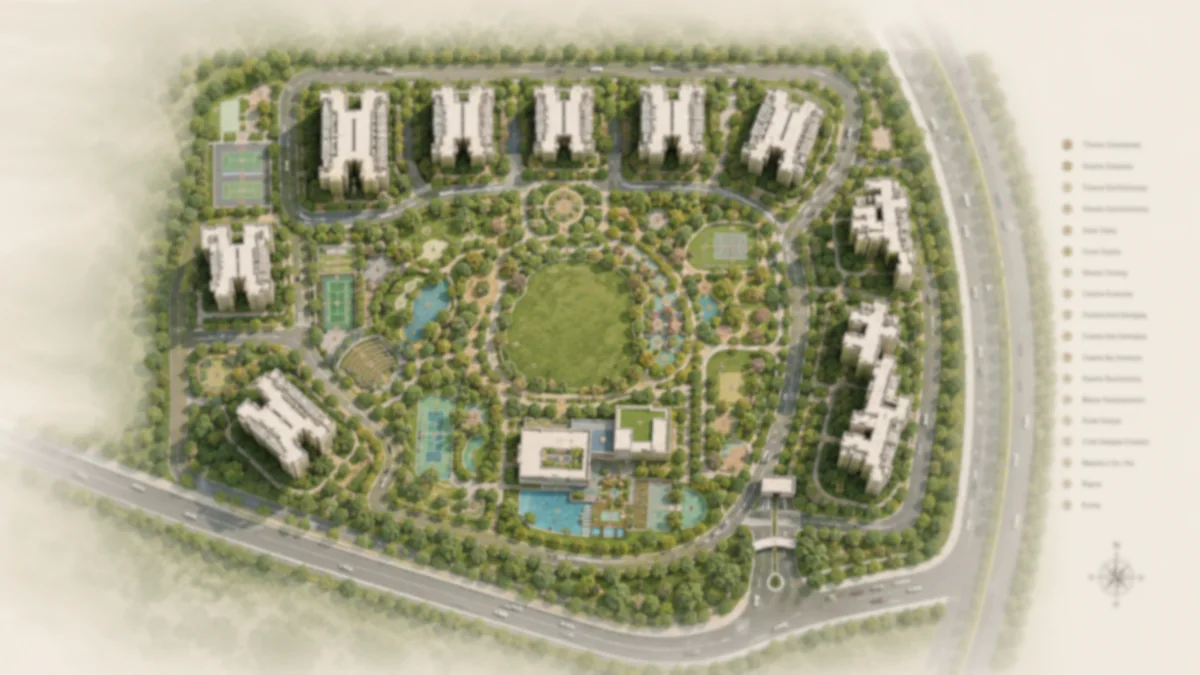
Why 20 acres changes the product
Most new apartment projects in Whitefield are built on two- to three-acre infill plots, because large contiguous land near the tech belt is scarce. On a small plot, a developer can fit a tower or two and a token amenity floor — but not a genuine community. There is no room for real open space, no separation between buildings, no proper clubhouse-and-sports precinct, and little scope to keep residents away from moving cars.
A ~20-acre canvas removes those constraints. It lets Godrej do what a township is supposed to do: keep a large share of the site as open, landscaped green space; give each tower breathing room and a garden aspect rather than a hard plot edge; consolidate the amenities into a substantial clubhouse and a dedicated sports zone; and lay an internal road network that separates pedestrians from vehicles. The scarcity of parcels this size in Whitefield is precisely why the corridor's marquee 2026 land deals drew the attention they did — land at this scale, in this corridor, is the raw material of a differentiated product.
Anticipated land-use philosophy
A Godrej township typically allocates its land across a handful of clear zones. For Godrej Whitefield, the anticipated land-use pattern — consistent with the Godrej template across the company's Bengaluru portfolio — is expected to look like this:
| Land-use zone | Anticipated role |
|---|---|
| Residential towers | Multiple high-rise towers holding the 2 / 3 / 4 BHK apartments, placed with garden aspects and inter-tower spacing |
| Open landscaped greens | The largest single land use — central green spine, pocket gardens, tree-lined edges; a high open-space ratio is the Godrej signature |
| Multi-tier clubhouse | A substantial standalone club building anchoring the community's social and wellness life |
| Sports precinct | Courts and fields — indoor and outdoor — clustered so that acoustic impact on homes is minimised |
| Family & wellness zones | Children's play areas, toddler zone, senior citizens' plaza, yoga / meditation decks, pet park |
| Internal circulation | A grade-separated road-and-pathway network; pedestrian spine kept clear of vehicular loops |
| Infrastructure & utilities | STP, water treatment, rainwater harvesting, DG / transformer yards, organic waste conversion — screened at the periphery |
| Convenience retail | A small in-township retail pocket for daily needs |
The through-line is open space. Godrej's township format leans heavily on landscaped greens, and on a ~20-acre parcel that translates into acres of genuine green rather than a strip of lawn. The precise open-space percentage is confirmed at launch; the design intent is a low-density, greens-first township where the buildings sit inside the landscape rather than dominating it.
Tower placement & density
The anticipated approach to tower placement follows three principles that recur across Godrej's township designs:
- Garden aspect for every tower. Towers are positioned so that primary living-room and bedroom faces look inward toward the central greens and landscape wherever possible, rather than onto the boundary road or a neighbouring facade. On a 20-acre site there is room to achieve this for most units.
- Inter-tower spacing. Generous separation between towers protects daylight, cross-ventilation and privacy — the opposite of the packed-tower geometry that small plots force. Spacing also lets the green spine flow continuously between the buildings.
- Low net density. By concentrating built form into efficient high-rise towers and keeping the ground plane open, the township achieves a lower net density than the land area alone would suggest — fewer neighbours per acre of usable outdoor space, faster amenity access, and a calmer campus.
The exact number of towers, their heights and the floors-per-tower are launch-pending and confirmed with the RERA filing. What the ~20-acre scale supports is a multi-tower configuration with room to spare — the anticipated 2 / 3 / 4 BHK ladder spread across the towers, with the larger 4 BHK homes likely occupying premium, garden- or higher-facing positions.
Circulation - people separated from cars
A well-designed township keeps residents walking through gardens, not dodging traffic. The anticipated circulation strategy for Godrej Whitefield is a grade-separated network:
- A single controlled entry-and-exit from the NH-648 side, with a security gateway, boom-barrier access and CCTV — one legible point of vehicular control for the whole campus.
- A peripheral vehicular loop feeding the tower drop-offs and the basement / covered parking ramps, kept to the edges rather than cutting through the central greens.
- A pedestrian spine connecting the towers to the clubhouse, the pool, the sports precinct and the play areas — clear of vehicular crossings, so children and residents move safely on foot.
- Cycle and jogging tracks woven through the landscape, separate from the car loop.
- Ample covered parking in basements / stilts, sized for the unit mix, with EV-charging provision.
The effect of separating people from cars is both safety and calm — the campus reads as a garden community rather than a car park with towers.
The multi-tier clubhouse and sports precinct
The social heart of Godrej Whitefield is anticipated to be a multi-tier clubhouse — a substantial standalone building rather than a partial amenity floor tucked inside a tower. Building the club as its own structure is the more expensive route, but it is what a township of this scale supports and what buyers at this price point expect. It delivers two structural advantages: programmable space — room for a full multipurpose / banquet hall, indoor games, a gym and fitness studio, a business / co-working lounge, wellness rooms and more, all without compromising apartment layouts — and acoustic separation, keeping the noise of events, fitness classes and indoor sports away from the residential towers. The clubhouse is expected to open onto the pool deck and the central greens so that the indoor and outdoor amenity zones flow into one another.
The anticipated outdoor amenity programme clusters the active-recreation elements into a sports precinct, typically placed toward a boundary so residential acoustic comfort is preserved: a swimming pool with a separate kids' pool connected to the clubhouse deck; outdoor courts for tennis, basketball half-court and futsal; a cricket practice net and a multipurpose sports lawn; a skating rink and outdoor gym; jogging, walking and cycling tracks and a reflexology pathway threaded through the greens; and an amphitheatre for community events. The amenities page sets out the full anticipated list.
Sustainability infrastructure - certified green
Godrej builds its Bengaluru townships to a third-party green-building certification (IGBC / LEED-class), and Godrej Whitefield is expected to follow suit. This is not decorative: certified green buildings run lower common-area energy and water consumption, which shows up directly in a resident's monthly maintenance bill, and they hold resale value better as buyers increasingly screen for sustainability. The anticipated environmental infrastructure includes a Sewage Treatment Plant (STP) with treated-water reuse for landscape irrigation and flushing; rainwater harvesting and recharge pits; solar-assisted common-area lighting; an organic waste converter (OWC) and segregated solid-waste handling; EV-charging provision in the parking areas; and native, drought-tolerant landscaping that lowers irrigation demand. The cumulative effect is a township that runs on a lower per-flat monthly maintenance load than a comparably-amenitised project without these systems — a real, recurring saving over the ownership horizon.
| Element | Anticipated approach |
|---|---|
| Land area | ~20 acres |
| Format | Integrated township — multiple high-rise towers |
| Open space | Greens-first; high open-space ratio (Godrej township standard) — exact % launch-pending |
| Clubhouse | Standalone multi-tier clubhouse |
| Circulation | Grade-separated; single controlled entry; peripheral vehicular loop; pedestrian spine |
| Parking | Covered basement / stilt parking with EV-charging provision |
| Green certification | Third-party (IGBC / LEED-class), per Godrej standard |
| Security | Multi-tier — CCTV, boom-barrier, gated access |
Read together, the anticipated master plan does what good township design does: it makes ~20 acres feel larger and more porous than the land figure suggests, by keeping the ground plane open, separating people from cars, and clustering the amenities into destinations worth walking to. The finalised master-plan drawing, tower layout and open-space percentage are released with the formal launch.
Godrej Whitefield master plan FAQ
Common questions on the ~20-acre scale, the tower count, the open-space approach, the green certification, and how circulation is handled at Godrej Whitefield.
How big is Godrej Whitefield and what is the format?
Approximately 20 acres near NH-648 Main Road in the Whitefield corridor, planned as an integrated township of multiple high-rise towers — not a standalone tower. The scale is what enables real open greens, a standalone clubhouse, and a dedicated sports precinct.
How many towers will Godrej Whitefield have?
The exact tower count, heights and floors-per-tower are launch-pending and will be confirmed with the RERA filing. The ~20-acre scale supports a multi-tower configuration with the anticipated 2, 3 and 4 BHK ladder spread across the towers.
What is the open-space approach?
Greens-first. Godrej's township format keeps a large share of the ground plane open, planted and walkable, with a central green spine threading between the towers. The precise open-space percentage is confirmed at launch; the design intent is a low-density, greens-first campus.
Is Godrej Whitefield a certified green project?
It is expected to carry Godrej's third-party green-building certification (IGBC / LEED-class), standard across the developer's Bengaluru launches — with an STP and treated-water reuse, rainwater harvesting, solar-assisted lighting, an organic waste converter and EV-charging provision, which lower running costs.
How is traffic handled inside the township?
Via a grade-separated circulation plan: a single controlled entry from NH-648, a peripheral vehicular loop kept to the edges, and a pedestrian spine connecting the towers to the amenities clear of vehicular crossings, so residents walk safely through gardens rather than dodging cars.
Get the Godrej Whitefield master plan
Register your interest to receive the finalised master-plan drawing, the tower layout, and the open-space breakdown the moment they are published at launch.
Contact us